
Why Nonstick Pans Are a Hot Mess
The reasons to get PFAS out of cookware go far beyond the kitchen.


You’ve probably heard by now that nonstick pans can be bad for you, and some states are eliminating the chemical culprits, called PFAS, from cookware. Celebrity chefs like Rachael Ray and David Chang (who just so happen to sell their own cookware lines) have also been stepping into the fray, defending their coating of pans with toxic chemicals. But just how much of a mess—in our bodies and in the environment—can these PFAS pans really make?
According to scientist Anna Reade, who leads NRDC’s PFAS program, it’s worth remembering that we’ve seen the very same chemicals wreak havoc before, just under a different name. “The thing that’s most appalling for the scientists, community members, and other advocates that have been involved in the PFAS work is how the industry is trying to separate itself from the storied history of Teflon,” she says.
Yes, Teflon—the very same Dupont-branded chemical that’s notorious for heavily contaminating communities near its manufacturing and disposal sites and increasing their rates of cancer and other chronic health conditions. Teflon’s scientific name is polytetrafluoroethylene (PTFE), a compound that other company brands now use too. PTFE is a type of PFAS, which is a class of synthetic compounds that persist in human bodies, wildlife, and the environment for several thousand years—so much so that they are often referred to as “forever chemicals.”
Learn More

As our scientific knowledge regarding these forever chemicals has grown, states have begun passing legislation to stop the sale of certain goods, such as cookware and dental floss, with PFAS. The laws apply to sales after a certain date—not to pans already in use—and many include a phase-out period to give companies time to pivot to safer alternatives.
So far, five states—Colorado, Connecticut, Maine, Minnesota, Rhode Island, and Vermont—have banned the sale of PFAS-laden nonstick pans, and New York has a bill in the works that would do the same.
California nearly joined these ranks as well, but Governor Gavin Newsom vetoed a bill in October over concerns that it might make pans less affordable. However, the truth is that consumers (and restaurants, too) can buy safer and more durable alternatives, such as stainless steel cookware, without breaking the bank. Major brands also already offer PFAS-free cookware lines, so there aren’t technological or supply chain issues keeping us from making the switch.
Of course, looming even larger are the costs we may pay, both with our health and our utility rates, as we address PFAS contamination in our food, soil, and drinking water supply.
Teflon: Indestructible destruction
A young scientist named Roy Plunkett accidentally created PTFE in 1938 while researching new refrigerants for DuPont. At first, the company didn’t know what to do with this seemingly indestructible material, but during World War II a few years later, PTFE played a small but vital role in the Manhattan Project and its development of the atomic bomb.
Health risks of nonstick cookware
Fluoropolymers, such as PTFE (Teflon) and substances with similar chemical structures, are basically PFAS-based plastic. “We’re talking billions of individual PFAS molecules that are bonded together to make a sheet of material that is then coated over a pan,” says Reade.
And what does plastic tend to do? Leach chemicals when heated and, over time, break apart into smaller pieces, creating microplastics and nanoplastics.
PTFE begins to break down and release toxic fumes at temperatures higher than 500 degrees Fahrenheit—for instance, anytime you broil a pan in the oven. These fumes are known to kill pet birds, and in humans, they can lead to polymer fume fever, or “Teflon flu.” Symptoms include chills, headaches, fevers, chest tightness, or coughing.
Scratching nonstick cookware (which is very easy to do) presents its own hazards. Studies have found that using damaged nonstick cookware can release millions of micro- and nanoplastic particles into your food. While scientists are just beginning to understand the risks of PTFE microplastic exposure, it has been linked to reproductive harm, including low sperm quality.
Up until 2015, manufacturers made PTFE with perfluorooctanoic acid (PFOA), a type of PFAS found in the blood of 99.7 percent of Americans. There has been extensive research on PFOA exposure, suggesting links to kidney and testicular cancer, thyroid disease, high cholesterol, and ulcerative colitis. Research has shown that the replacing of PFOA with other forever chemicals by the industry is also problematic.
Teflon’s toxic reach outside the kitchen
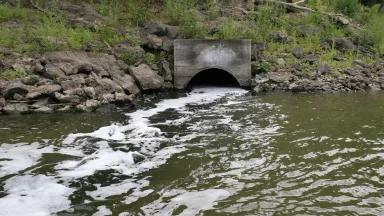
Meals prepared on overheated or scratched nonstick pans, however, are far from the only way that PTFE can get into our bodies. According to Reade, by the time a brand new PTFE pan makes it to your kitchen, it’s already done a lot of damage, merely by existing. That’s because the manufacturing and disposal of PTFE is when PFAS finds its way into the air, soil, and waterways. Indeed, an estimated 80 percent of the PFOA in the environment comes from PTFE products.
“Life cycle is so important. You could not personally buy any PFAS stuff and still be exposed through the environment,” says Reade. And the PFAS we’re finding in our water supplies today may very well come from PTFE that was made decades ago.
Communities near Teflon production facilities know this firsthand—most notably, the residents of Parkersburg, West Virginia, whose story was depicted in the films Dark Waters and The Devil We Know. Over the course of 50 years, PFOA billowed out of DuPont’s smokestacks while the company also dumped 1.7 million pounds of it into the nearby Ohio River and into landfills from where it leached into creeks and groundwater.
The first clue that something was wrong was when more than 150 cows died after drinking from a stream near a DuPont landfill. News later surfaced that the water supply of about 70,000 people had been contaminated for decades. The research that resulted from litigation against DuPont concerning the pollution found links between the residents’ PFOA exposure and cancer, liver and thyroid disease, cardiovascular problems, high cholesterol, and pre-eclampsia.
A few years later and a few hundred miles down the Ohio River, a different community felt the impacts of PTFE disposal. Since the 1990s, a company called Shamrock Technologies in Henderson, Kentucky, had recycled PTFE products by grinding and baking them, releasing PFAS by-products into the air through its smokestacks. From there, the forever chemicals found their way into waterways and the city’s aquifer. A Louisville Public Media (LPM) investigation in 2021 found that the city had tried to keep the contamination quiet.
“It’s like not telling people that there’s a tornado coming. I mean, you can’t do anything about it, but you have to at least know this is a possibility so you can act accordingly,” Velvet Dowdy, a local chemistry teacher who looked into the issue, told LPM. “If you came into contact just a couple of times with contaminated soil or contaminated water, you could max out your lifetime exposure just in that case.”
The contamination was so bad that the city, where most residents are low-income, lost out on a $102 million investment. A food production company had planned to open a factory along the river, offering nearly 100 jobs, but it backed out after discovering it wouldn’t have access to clean groundwater.

New forever chemical, same mess
After manufacturers began phasing out PFOA a decade ago, they began making PTFE with another PFAS chemical called GenX. Because GenX has a slightly shorter chemical structure, the industry argued that people would be able to excrete it quicker than PFOA, which lingers in the body for years. While that’s true, GenX remains in the environment just as long. So, if companies produce GenX just as abundantly, people will still be chronically exposed.
GenX has many of the same health concerns as PFOA, which the U.S. Environmental Protection Agency (EPA) designated as a hazardous substance in 2024. That same year, the EPA set strict drinking water standards for six PFAS, including both PFOA and GenX. (The EPA noted that the new standards could protect the drinking water of about 100 million people, and yet the Trump administration plans to delay the compliance deadlines for the PFAS limits by years.)
What it comes down to is as soon as we manufacture PTFE, it’s in our environment for good. “Once we get to that point, it’s a sunk cost. The products have already been made, and there’s nothing we can do about it,” says Reade. “It’s going into the landfill or back into the environment somehow.”
The obvious solution is to stop producing and using PTFE altogether—and keeping it out of our kitchens is a good place to start.
Best practices for lowering PFAS exposure while cooking
- Replace traditional nonstick pans with safer alternatives, including stainless steel, ceramic, cast iron, or carbon steel.
- Do your due diligence when shopping. Consumer Reports found that even cookware labeled “nontoxic” contained traces of PFAS.
- Create temporary nonstick surfaces with heat and butter or cooking oils.
- If replacing your nonstick pan isn’t an option right now, follow usage instructions provided by the manufacturer, such as maximum temperature warnings.
- Remember that heating a nonstick pan while empty will increase its chance of overheating and releasing toxic fumes.
- Use wooden utensils instead of metal ones to prevent scratching the nonstick coating, and do not use once it’s damaged or older than five years.
This NRDC.org story is available for online republication by news media outlets or nonprofits under these conditions: The writer(s) must be credited with a byline; you must note prominently that the story was originally published by NRDC.org and link to the original; the story cannot be edited (beyond simple things such as grammar); you can’t resell the story in any form or grant republishing rights to other outlets; you can’t republish our material wholesale or automatically—you need to select stories individually; you can’t republish the photos or graphics on our site without specific permission; you should drop us a note to let us know when you’ve used one of our stories.
How to Limit Your PFAS Exposure in the Great Outdoors
Should Harmful Pesticides Come with Warning Labels?
Mercury’s Journey from Coal-Burning Power Plants to Your Plate